
Europe cannot afford to remain economically inward-looking
The European Union today faces a structural growth challenge. Its internal market is highly developed but increasingly mature, constrained by demographic ageing, slower productivity growth, rising regulation and energy costs.
The EU’s working-age population is projected to decline by around 6% by 2030, while productivity growth has averaged below 1% annually over the past decade. In this context, long-term prosperity can no longer be driven primarily by intra-European demand. Instead, Europe’s future economic performance will increasingly depend on its ability to secure access to large, fast-growing external markets.
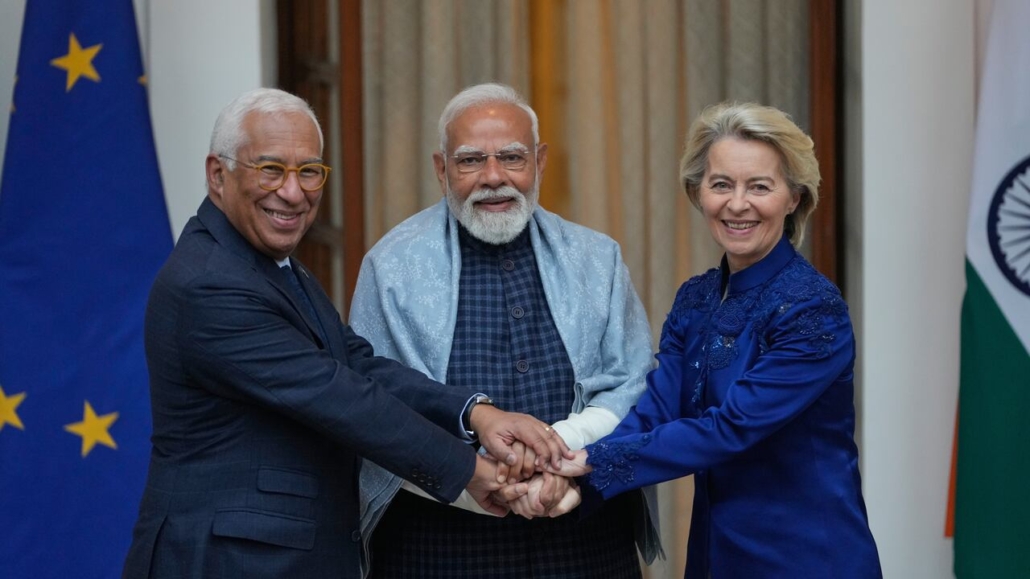
The European Union recently concluded a free trade agreement with India. This agreement, described by leaders on both sides as the “mother of all trade deals”, provides a powerful illustration of this shift in economic strategy.
The agreement establishes the world’s largest free-trade zone by population, encompassing nearly two billion people and representing approximately 25% of global GDP. After almost two decades of negotiations, it stands as one of the EU’s most strategically significant trade breakthroughs since Brexit. It comes a few weeks after the signing of the EU-Mercosur trade agreement.
At a headline level, the economic gains are substantial. The agreement will eliminate or reduce tariffs on almost 97% of EU exports, saving European companies an estimated €4 billion per year in duties. EU–India trade already exceeds €180 billion annually, supporting close to 800,000 EU jobs, and the European Commission expects EU exports to India to double by 2032 as the agreement is implemented.
India’s relevance is not accidental. It is now the world’s fastest-growing major economy, with GDP growth averaging 6-7% per year. The IMF projected that it will become the fourth-largest economy globally in 2025.
But the real importance of such agreements goes far beyond trade flows.
Modern trade policy is no longer solely about increasing exports. We are moving from just exports to economic multipliers.
The future is about generating system-wide economic multipliers that cascade through investment, services, labour mobility and innovation.
Large trade agreements typically trigger a second wave of economic activity through cross-border investment.
Companies do not simply export; they establish subsidiaries, joint ventures, financing vehicles, supply chains and operational hubs. Empirical work by the OECD suggests that every €1 of additional trade generates between €1.3 and €1.6 in total economic output, once investment and service effects are accounted for.
A third layer follows in services and professional sectors. Services already account for around 70% of EU GDP and employment, and over 55% of the value added embedded in EU exports. As trade volumes grow, so does demand for legal services, compliance, audit, risk management, digital infrastructure, payments, insurance and asset management. These are high-value activities that generate sustained employment and fiscal revenues.
In practical terms, large trade agreements translate into growth for financial services, aviation leasing, maritime services, fintech, gaming, regulatory technology, and international advisory sectors – areas in which small EU economies are structurally competitive and where margins are significantly higher than in goods manufacturing.
In the future, the EU-India agreement illustrates a broader strategic reality.
Europe’s internal market, while large, is no longer sufficient on its own to sustain long-term growth. In a world where economic momentum is shifting towards large emerging economies, Europe cannot afford to remain economically inward-looking.
Access to large global markets is no longer optional. It is now a core requirement for Europe’s economic relevance, resilience and long-term prosperity in the 21st century.
This article was published on the The Times 10th March 2026

